Should I do embryo screening?
If you're going through IVF and someone mentioned polygenic embryo screening, you're probably wondering whether it's worth the extra step. Most fertility doctors won't bring it up. The ones who do often don't know much about it. And the information online is a mess of cautious professional statements, marketing copy, and outdated takes.
So let me just be direct about what actually matters for this decision.
It starts with how many embryos you have
PGT-P works by comparing genetic risk across your embryos. With one embryo, there's nothing to compare, though the information might still help you understand your child's risk profile. With two, the comparison is limited. Three or more is where you start to see real differences.
Generally speaking, you need about twice as many euploid embryos as you want children before polygenic embryo screening starts making sense. There are some cases where fewer embryos can work, but generally speaking, the more the better.
If you're early in the process and want to estimate your expected embryo count, our IVF calculator can help.
PGT-P adds a layer of genetic information to an existing IVF cycle. If you're already on that path, adding this step is straightforward.
Family history changes the math
Here's where it gets interesting. When your baseline risk for a condition is elevated, the absolute risk differences between embryos tend to be larger. For families in which both parents have type 2 diabetes, the absolute risk differences between the highest and lowest risk embryos can be above 40% (and in some cases higher).
That's a large difference.
Other parents who don't have any specific family history they're worried about might be more interested in the common diseases that affect large portions of the population — type 2 diabetes, heart disease, Alzheimer's. These conditions have meaningful genetic components, and PGT-P can show you which embryos carry higher or lower risk for each.
You can explore the expected risk differences for specific conditions using our screening tool.
You don't need a new biopsy
When PGT-P first came out, the only way to get access was by going to a clinic that worked with either Genomic Prediction or Orchid. Data from the results generated by those two companies could either be used on its own to pick an embryo or sent to a company like Herasight for deeper genetic analysis.
This changed in 2025, when scientists at Herasight discovered a way to reconstruct a full embryo genome using data from a much more routine genetic test called PGT-A. We realized it was possible to take low-quality PGT-A test results and combine them with a high-quality genetic sequence of the parents to create a high-quality genotype of all embryos.
This means if you've already done genetic testing on your embryos, it's very likely you'll be able to do polygenic embryo screening. There are some countries in which this process is more difficult (Australia, for example), so if you're outside the US, it's best to reach out to our team before starting the process.
Ancestry matters
Most polygenic scores have historically worked best for people of European ancestry. That's a real limitation, and it directly affects what the scores can tell you. Herasight calibrates across 8+ ancestry groups, but performance still varies by condition and ancestry. If you're non-European, ask specifically about the conditions you care about. The answer will be different for type 2 diabetes than for schizophrenia.
These are probabilities, not guarantees
PGT-P tells you "this embryo has an X% risk of developing condition Y." It doesn't tell you "this embryo will or won't get sick."
For the statistics nerds: the best way to think about what embryo screening does is it shifts and narrows the distribution for a given trait. For example, here's a graph showing the distribution of IQ scores for a random embryo and one with a predicted IQ of +8:
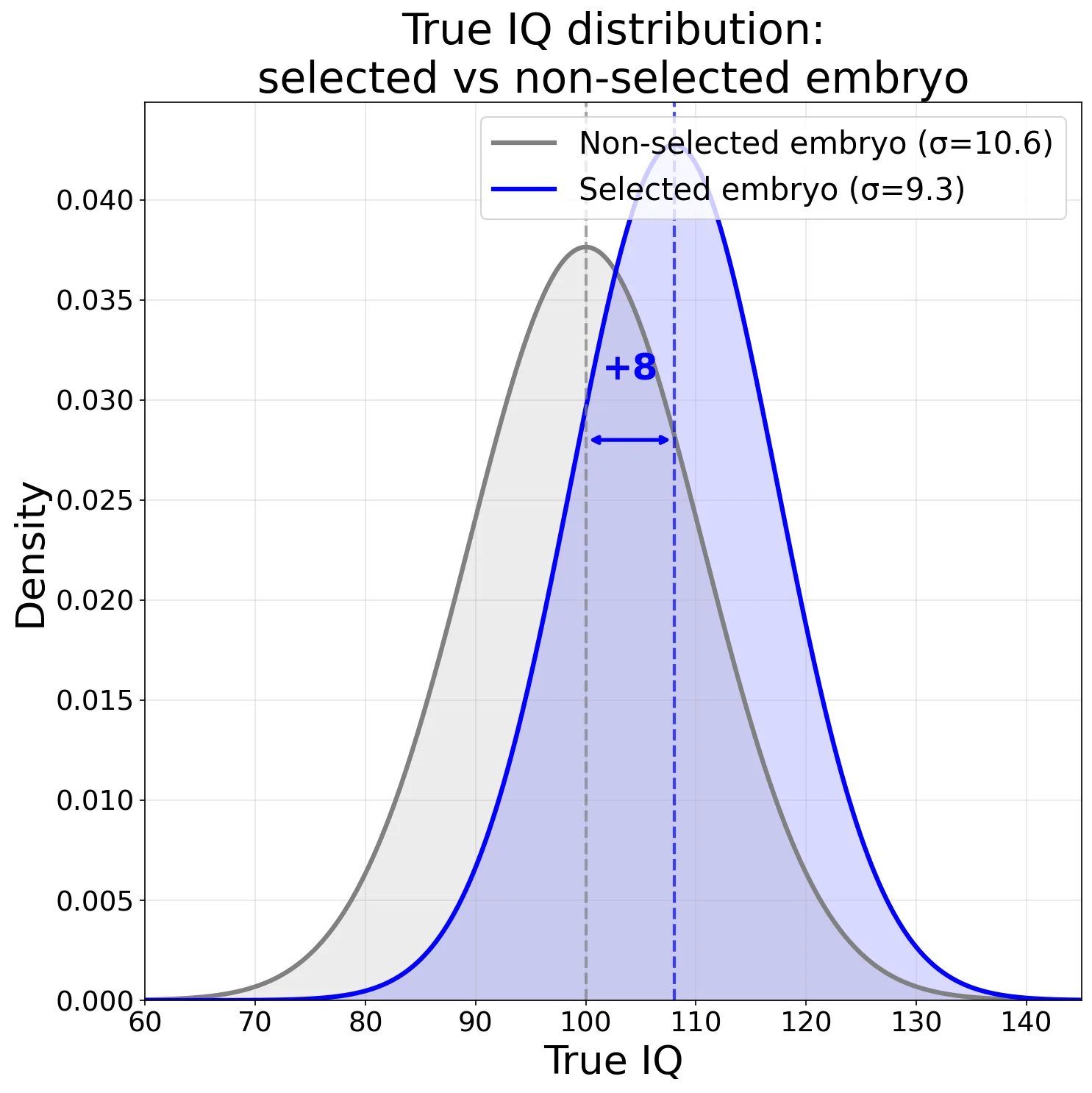
There's still a pretty significant overlap between the two distributions. Sometimes the embryo with the highest predicted IQ won't end up being the smartest kid. The same goes for disease risk.
But this technology can significantly tilt the odds in your child's favor. For conditions like diabetes or Alzheimer's, you really do see meaningful separation between high-risk and low-risk embryos.
Here's the part most people don't think about: these conditions aren't all-or-nothing. Someone with a high genetic risk for type 2 diabetes might never get a formal diagnosis but still spend years dealing with fatigue, insulin resistance, and the metabolic effects that come with elevated blood sugar. The line between "has the disease" and "doesn't" is blurrier than a risk percentage suggests. Our counselors can explain what the scores actually mean for your quality of life. Not just a diagnostic label.
If you want to talk through how these numbers apply to your family, reach out to us.
What about your doctor?
If your RE is skeptical about polygenic screening, that's the norm right now. Only 12% of U.S. reproductive endocrinology specialists approve of PGT-P, and there's a documented gap between where clinicians stand and what patients are asking for.
The disconnect isn't because the evidence doesn't exist. Herasight tested 17 disease scores on sibling pairs — the relevant benchmark, since embryos from the same IVF cycle are siblings — and 16 of 17 showed no decrease in predictive performance. Genomic Prediction published sibling validation on 11,883 pairs. Nucleus validated 9 scores within families with comparable results. Independent researchers like Shai Carmi at Hebrew University have modeled the expected gains and found real gains are achievable. A 2024 review in Human Reproduction Update confirmed that the science supports polygenic embryo screening. Most RE specialists just haven't engaged with any of it.
Your doctor knows a lot about IVF. But on this specific question, the data is worth looking at yourself.
Comparing providers
If you're comparing companies, three things matter most: how well their scores predict disease risk, what conditions they screen for, and what they charge.
Predictor performance
This is the most important axis. The chart below shows the variance explained (R²) by each company's polygenic scores across key diseases. Higher is better.
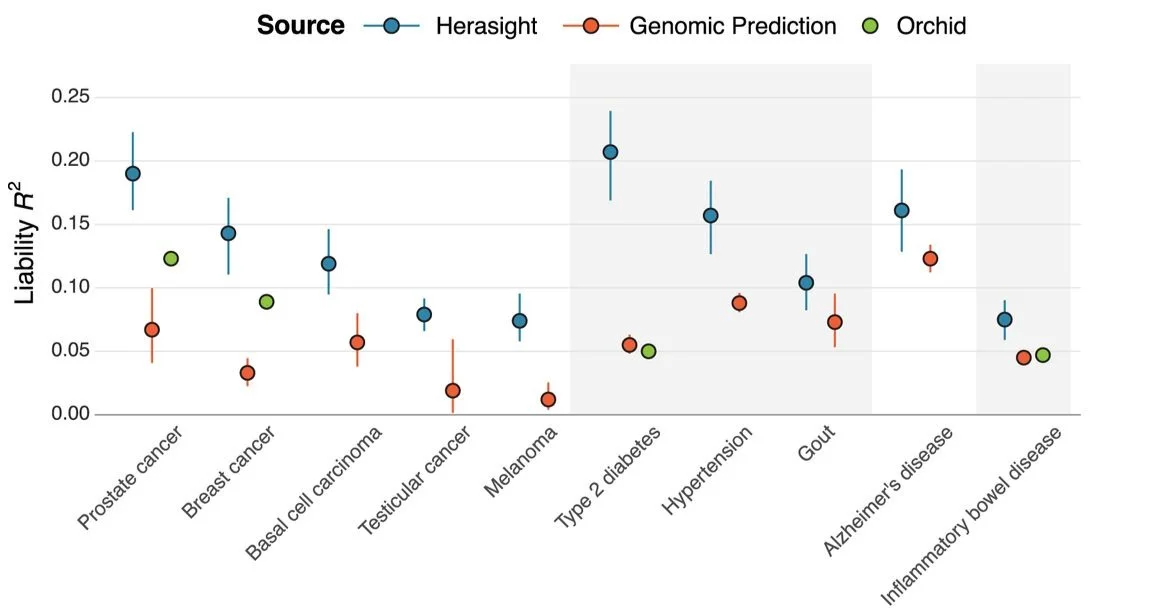
On average, Herasight's scores explain 122% more variance than Orchid's and 193% more than Genomic Prediction's across overlapping traits. Nucleus's recently published scores (Cordogan et al. 2025) are the closest competitor — they validated 9 scores within families, compared to Herasight's 17.
Validation method matters too. Validating on unrelated people can overstate accuracy for some conditions because it picks up population-level signal that siblings share. Both Herasight and Nucleus have published within-family validation. Orchid and Genomic Prediction have not.
What each company screens for
A high-performing score doesn't help if the company doesn't screen for the conditions relevant to your family.
Herasight screens for 17+ diseases including type 2 diabetes, breast cancer, coronary artery disease, Alzheimer's, schizophrenia, and prostate cancer, plus cognitive traits through CogPGT. Orchid covers about 15 polygenic conditions and bundles PGT-A with whole-genome sequencing. Genomic Prediction offers 12 conditions but with limited ancestry coverage outside European populations. Nucleus recently launched Origin with 9 validated disease scores.
Price
PGT-P is almost entirely an out-of-pocket cost, and pricing models across the industry are difficult to compare directly because providers bundle fees differently.
Some companies charge a flat per-embryo fee, typically ranging from $2,500 to $3,500. Others sell tiered analysis packages that scale up to $30,000 or more depending on what you include.
At Herasight, pricing depends on the number of conditions you're screening for and your total embryo count. Because every family's panel is custom-built, we don't list a single flat rate on the website. You'll get an exact quote during your first counseling session, which is included with every engagement to ensure you understand exactly what the scores can and cannot tell you.
If you want to understand what PGT-P does before deciding, start here. If you're ready to talk specifics, reach out to our team.