What does a genetic counselor do?
If you're going through IVF and your clinic hands you a report with risk percentages for a dozen conditions across five embryos, chances are you're going to stare at it and feel completely lost. A genetic counselor is the person who turns those numbers into a decision you actually feel good about. They look at your family history, explain what the scores mean for your specific situation, and help you weigh trade-offs that no PDF can walk you through on its own.
At Herasight, every client works with a counselor who specializes in polygenic embryo screening. It's built into the service, not an add-on. You can reach out to us here if you'd like to talk to one of our counselors about your results or about getting started.
Most genetic counselors aren't trained for this
Most genetic counselors are trained to deal with simple genetic conditions. Diseases like sickle cell or cystic fibrosis are caused by a single gene. If you have a family history of breast cancer, a typical genetic counselor can explain to you the result of a BRCA screening.
But most diseases aren't caused by one gene. And most people who have a family history of breast cancer don't have rare, highly impactful genetic variants like BRCA.
For these complex diseases, there are often hundreds of genes involved. What really matters is not necessarily which ones you have, but how many.
Genetic counselors trained to deal with polygenic diseases like breast cancer understand this, and can explain to you what a polygenic risk score is and how to interpret it in the context of your embryo reports.
They can also explain to you how to think about the tradeoffs between different disease risks. Sometimes one of your embryos might have a low risk of breast cancer but a high risk of heart disease, and another might have a high risk of breast cancer and a low risk of heart disease.
Counselors who understand polygenic embryo screening can help you think about these tradeoffs and make the choice that takes into account both the science and the things that matter most to you.
This is why, if you're screening for a condition like autism or diabetes involving multiple genes, speaking with a counselor who understands polygenic embryo screening is important. Our team can help if you'd like to talk to someone who knows this data.
Why the counselor matters more than the score
Think about what you're actually looking at when you get an embryo screening report. You've got risk estimates for potentially a dozen or more conditions across multiple embryos. One embryo might show a 25% risk for type 2 diabetes, another shows 35%. A third has a lower diabetes risk but a slightly elevated risk for something else.
What do those numbers mean?
It depends. A 25% risk of type 2 diabetes is higher than average if nobody in your family has the condition but actually quite a good outcome if both your parents are diabetic. And the seriousness matters — to most people, a 25% risk of diabetes is much less scary than a 25% risk of something like schizophrenia. A counselor helps you weigh the actual stakes, not just the numbers.
This is where Herasight's counselors spend most of their time. They incorporate your family history into the baseline risk calculation, because family history modifies baseline risk in ways that most providers simply ignore. Our tests incorporate both your actual genetic risk for different conditions, and your family history. This is important because some people can end up at high risk for a condition through bad luck, even though they have no family history. All these factors are taken into account when we generate our embryo report.
No embryo will be "best" for everything. It's statistically impossible. So when you're picking an embryo, it really is all about making the right tradeoffs. Without someone who can give you a framework for thinking through these tradeoffs, the choice can feel overwhelming.
There's another layer most people miss: these conditions aren't all-or-nothing. Someone with a high A1C may be technically "pre-diabetic" and never get a formal diabetes diagnosis, but they're still dealing with fatigue, insulin resistance, and the metabolic effects that come with it. The line between "has the disease" and "doesn't" is blurrier than a risk percentage suggests, and a counselor who understands this can explain what the scores actually mean for quality of life, not just for a diagnostic label.
How it actually works
Genetic counseling for embryo screening happens in two phases. A typical appointment lasts 30-60 minutes, though PGT-P sessions often cover more ground than a standard genetics visit.
Before testing, the counselor collects your family medical history, explains what PGT-P can and can't tell you, and helps set realistic expectations. This matters because understanding up front that these are probabilities, not certainties, shapes how you interpret the results later.
The counselor will walk you through your results, showing you the risk spread in your embryos for conditions like ADHD, diabetes and IQ.
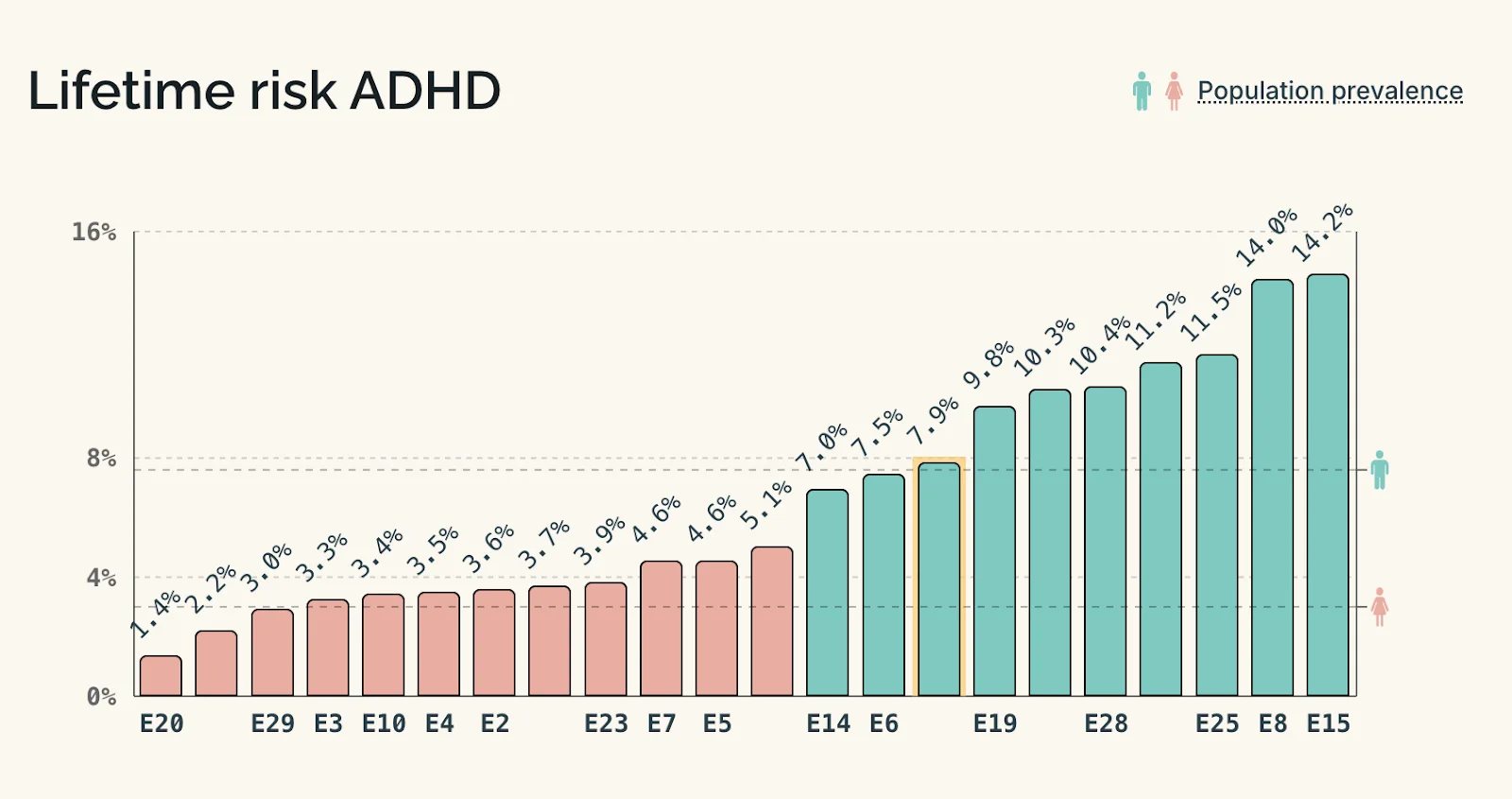
Sometimes we'll find that PGT-P will work better for you than an average couple. This is especially common for conditions like Alzheimer's, where the presence of a single high impact variant can massively increase the risk difference between embryos.
Sometimes we'll find that it works less well. For example, many people with type 1 diabetes have two high risk genetic variants, so there won't be much difference between their embryos.
This is one of the reasons we recommend parents get themselves screened before starting IVF; if they're specifically interested in reducing their risk of a particular disease, we can give them a better idea of how well embryo screening is likely to work for them before paying for the process.
After results come back, the real work happens. The counselor walks you through the embryo report, puts each risk score in context against your family history and population baselines, and helps you see what the trade-offs actually look like. Carrier screening is part of this workflow too, because single-gene conditions need to be accounted for alongside polygenic risks. And for families dealing with mosaic embryo results, where some cells show chromosomal abnormalities and others don't, the conversation gets even more important. Those decisions involve genuine uncertainty that only a real human conversation can work through.
Top academic medical centers integrate genetic counseling directly into their IVF programs for exactly this reason. The testing and the interpretation can't be separated.
At Herasight, counseling isn't a separate charge or an optional add-on. We built the service around the premise that data without interpretation isn't a complete product. Some providers deliver a PDF and leave you to figure it out. We think the counselor IS what makes the screening useful.
If you're interested in learning more about how our counselors work with families going through PGT-P, reach out to us.