Herasight vs Juniper Genomics: what will the results tell you?
When several embryos are available for transfer, you may want to understand how they differ in future risk of diseases such as diabetes or heart disease. At Herasight, we offer polygenic embryo screening, or PGT-P, to estimate those differences. Juniper Genomics’ PGT-G investigates individual genetic changes related to embryo development, pregnancy loss and genetic conditions. It explicitly excludes polygenic risk scores.
In a sense, Herasight and Juniper are offering very different products. However, Juniper has made a rather extraordinary claim. Their website argues that identifying genetic causes of embryo failure and pregnancy loss will help patients achieve a live birth with fewer transfers. We doubt some of their central claims, and we explain the source of our skepticism here.
One of the main causes of pregnancy loss is aneuploidy, meaning an embryo has an abnormal number of chromosomes. Around 60% of first-trimester miscarriages involve chromosomal abnormalities, and this fraction increases with maternal age (Menasha et al., 2005). Preimplantation genetic testing for aneuploidy, or PGT-A, was a major advance because it allows doctors to identify aneuploid embryos before transfer and prioritize euploid embryos, meaning embryos with a normal number of chromosomes. This can reduce implantation failures and miscarriages.
But aneuploidy is only part of the story. Even a single euploid embryo transfer results in a live birth only about 50% to 60% of the time (ASRM, 2024). Why so many euploid embryos still fail remains largely unexplained. Some losses may have nothing to do with the genetics of the embryo. Others may be caused by genetic changes that are much smaller than a missing or extra chromosome. The question is how much these smaller variants contribute to embryo loss, and whether testing for them can meaningfully improve IVF outcomes.
One proposed way to improve embryo selection is to use whole-genome sequencing to look for these smaller changes. Juniper Genomics markets its “PGT-G” test for this purpose. Juniper claims that it can identify causes for at least 85% of adverse pregnancy outcomes. Here, we evaluate whether the evidence supports Juniper’s claims.
What sequencing can explain
To assess Juniper’s 85% number, we first looked at what sequencing can explain after a pregnancy loss. A recent Nature study examined 467 pregnancy losses, comparing DNA from each pregnancy with DNA from both parents. Chromosomal abnormalities accounted for most of the identified causes. Aneuploidy explained 44.1% of losses, while triploidy, meaning a complete extra set of chromosomes, explained another 6.4%. Small genetic changes classified as disease-causing accounted for roughly 3%, and new deletions or duplications of sections of DNA for 1.3%. The small-variant estimate came from a narrower group of samples with tissue suitable for detecting new mutations.
Among 141 pregnancy losses with a normal chromosome count, the researchers found 12 cases with small genetic changes classified as disease-causing. These changes also appeared in living adults, so finding one did not necessarily explain the loss. However, they were about three times as common in the pregnancy-loss group. From that difference, the researchers estimated that they had caused around eight of the 141 losses, or about 6%. This estimate is based on only 12 cases and remains uncertain.
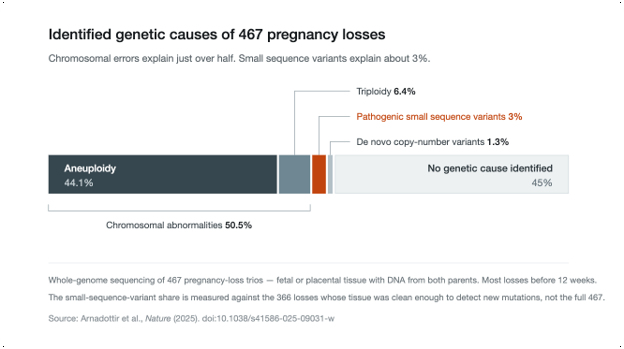
Only two of these genetic findings were inherited, which is the type of risk carrier screening can sometimes identify. Both were found in couples who had experienced three consecutive prior losses. The other 10 involved new mutations in the embryo, meaning they could not have been detected through routine parental testing. Detecting these variants from a biopsy containing only a few embryonic cells is also technically difficult. Another limitation is that a variant is generally classified as pathogenic only after its gene has been linked to a condition observed in living children. Genes that are essential to the earliest stages of development may therefore be among the easiest to miss. Known pathogenic small sequence variants explain a minority of the recognized euploid losses in this study. That does not establish how much genetic variation contributes to losses before a pregnancy is recognized or to failed embryo transfers.
These findings leave considerable uncertainty about how much genetic variation contributes to embryo failure and how much of it a test can identify today. Juniper’s FAQ claims that its technology finds errors accounting for “over 85% of IVF failures and pregnancy losses.” To assess that figure, we needed to know which studies it was based on, which outcomes those studies examined, and how their results had been combined.
Following the evidence
We asked Juniper how it calculated the 85% figure for causes of adverse pregnancy outcomes. CEO Jeremy Grushcow referred us to two publications - Byrne et al. (2023) and Zhao et al. (2021).
Byrne and colleagues studied 200 families who had experienced a pregnancy loss or the death of a newborn. In about two-thirds of cases, the pregnancy had been terminated after scans showed serious problems with the baby’s development. Earlier genetic tests had not found an explanation. Sequencing gave a clear genetic diagnosis in about a quarter of families, with possible explanations in another quarter. The study helped explain problems that had already occurred, but it did not test whether sequencing could predict which IVF embryos would lead to a live birth, especially having in mind that it was based on a highly pre-selected sample.
The other study, by Zhao and colleagues, examined tissue from 102 miscarriages and stillbirths. Cases with chromosome abnormalities or known harmful deletions or duplications of DNA had already been excluded. The researchers found genetic changes classified as disease-causing or likely disease-causing in 22% of the remaining cases. The figure rose to 35% only when they included changes whose effects were uncertain, but which they suspected could cause disease.
We could not find a calculation connecting these studies to the 85% claim, so we asked Juniper to walk us through it. Grushcow said he was confident the references supported the claim, but that the company did not have the bandwidth to provide further support for the article.
The denominator in Zhao and colleagues’ study is important. Its sample excluded losses with chromosome abnormalities, so its diagnostic yield cannot simply be added to the share of all losses attributed to those abnormalities.
For illustration, if chromosome abnormalities explain half of pregnancy losses, a 35% yield among the remaining half adds 17.5 percentage points, for 67.5% overall. That is an arithmetic example, not an estimate of losses that screening could prevent. The study’s 35% figure also includes uncertain findings, which should not be treated as established causes of loss.
The studies discussed here investigate genetic findings after pregnancy loss or perinatal death. They do not establish how often an embryo with a particular finding would fail to produce a live birth, or whether using PGT-G to choose embryos improves that outcome. Presenting fewer transfers as an established benefit goes beyond the evidence considered here.
Does reducing disease risk increase IVF success?
At Herasight, we offer PGT-P, which is intended to reduce the risk of disease. The relationship between polygenic risk scores and miscarriage is still unclear, so we do not present PGT-P as a general test of embryo viability. Our research on rare-variant genetic load likewise concerns associations with cognition and neurodevelopmental or psychiatric conditions. It does not establish that screening improves implantation rates or overall IVF success.
What would establish a benefit
Researchers could run PGT-G on embryos that PGT-A had classified as having a normal chromosome count. The new results would initially be kept from influencing which embryos are transferred. Researchers could then compare implantation, miscarriage, ongoing pregnancy and live-birth rates between embryos the test rated as more or less likely to succeed. The comparison would need to account for other factors that affect these outcomes. That would help establish whether the test adds useful predictions beyond PGT-A. Whether using those predictions to choose embryos improves patients’ chances of having a baby would still need to be assessed.
The consequences extend beyond the order of transfer. Juniper’s FAQ describes a patient with three embryos, all classified as non-viable, starting another cycle immediately. It characterizes transferring those embryos as waiting for “a live birth that would never come.” That conclusion requires knowing how often embryos given that classification can, in fact, result in a live birth. The assessment must therefore include patients’ overall chances of a child, taking account of embryos that are never transferred.
Future research may identify additional genetic causes of embryo loss and eventually improve embryo selection. There is a good reason to keep studying these variants. For patients, the practical question is whether using a test improves their chance of a live birth, and how often embryos it ranks lower would also have succeeded.
The studies examined here do not establish that PGT-G identifies the causes of over 85% of IVF failures and pregnancy losses, or that using it to select embryos reduces the number of transfers needed for a live birth. Those claims require evidence about the relevant patients and outcomes. Finding a genetic variant after a loss is a different result from showing that a test improves IVF success.
People rightly have questions about PGT-P, including our own services at Herasight. That is why we publish validation studies that test our predictions and allow others to examine the evidence behind them. We believe this is essential to moving the field forward.
We share the goal of increasing the success rate of IVF. That is exactly why we think it is important to be clear about where the science stands, what genetic testing can already do, and what still needs to be proven.